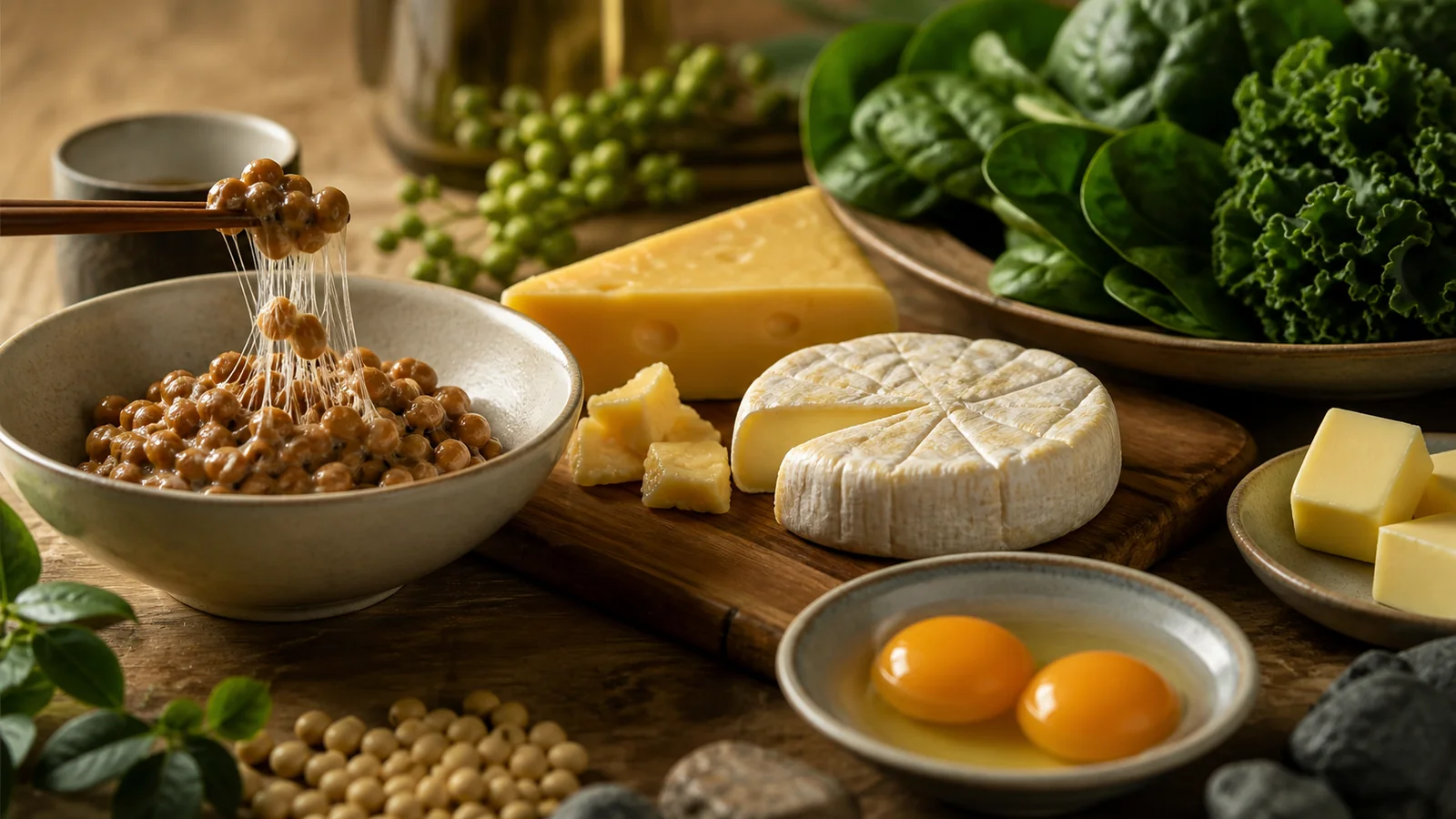
Vitamin K2 is often described as the nutrient that helps direct calcium into bone and away from arteries. This is a convenient shorthand for a more complex mechanism: K2 can supply vitamin K activity to proteins that require carboxylation in order to bind calcium and function properly. The mechanism is well established, but evidence for the clinical benefits of supplementation is not equally strong in every setting.
Weston Price's observations
Weston A. Price was a Canadian-born dentist working in Cleveland. During the 1930s he travelled widely and documented the teeth, facial development, diets and living conditions of communities that were relatively isolated from industrial food. He compared them with nearby groups eating more white flour, sugar, refined fats and packaged food.
Price reported fewer cavities and broader dental arches in many of the traditionally nourished groups. He became convinced that the difference could not be explained by brushing alone. Their diets varied enormously, but many included mineral-rich foods and concentrated sources of fat-soluble nutrients: seafood, fish eggs, organ meats, eggs, dairy fat or carefully prepared fermented foods.
These observations were ambitious and historically important, but they were not modern controlled trials. Price mixed careful documentation with conclusions that sometimes ran beyond what observational fieldwork could prove. His photographs and dietary records can generate hypotheses. They cannot, by themselves, establish that one nutrient caused every difference he saw.
How Activator X came to be identified with vitamin K2
Price analysed butter samples and experimented with a fat-soluble fraction that appeared to vary with season and animal feeding. He found the strongest signal in butter from cows eating rapidly growing green grass. He also associated the factor with animal organs, fats and fish eggs. In the 1945 edition of Nutrition and Physical Degeneration, he called it a "new vitamin-like activator" because he believed it helped the body use minerals and work with vitamins A and D.
He did not determine its chemical structure, and he did not discover vitamin K2 in the modern biochemical sense. The name Activator X was an admission that the substance was unknown. Decades later, writers examining the foods, chemical test and physiological effects described by Price proposed that Activator X was probably a form of vitamin K2, particularly menaquinone-4, or MK-4. The correspondence is plausible, but it remains a retrospective identification rather than a laboratory confirmation performed by Price.
Price may therefore have been tracking a vitamin K-related signal before the roles of vitamin K-dependent proteins outside the liver were understood. This is a plausible and historically interesting interpretation, but it should remain an interpretation rather than be presented as a confirmed fact.
Where K2 sits inside the vitamin K family
Vitamin K1, or phylloquinone, is concentrated in green vegetables. Vitamin K2 is a family of menaquinones, named MK-4 through MK-13 according to the length of their side chain. MK-4 occurs in some animal foods and is also made inside human tissues. Human cells use the enzyme UBIAD1 to convert vitamin K-derived material into MK-4. Longer-chain menaquinones are produced by bacteria and occur in fermented foods. Natto is especially rich in MK-7, while cheeses can provide a mixture of longer-chain menaquinones.
The forms differ in absorption, circulation and tissue distribution. MK-7 remains in the blood much longer than MK-4, while MK-4 is widely present in extrahepatic tissues. It is therefore misleading to speak about every form of K2 as though it were pharmacologically identical.
A note on terminology: vitamin K is the family name. K1 is phylloquinone, while K2 refers to the menaquinones. They share the vitamin K cycle and can support the carboxylation of vitamin K-dependent proteins, but they differ in food sources and pharmacokinetics. When the evidence concerns the whole family, this article says vitamin K. When it concerns menaquinones, it says K2, MK-4 or MK-7.
The vitamin K carboxylation mechanism
The central job shared by K1 and K2 is to supply a cofactor for gamma-glutamyl carboxylase. This enzyme modifies specific proteins through a process called carboxylation. Once carboxylated, those proteins can bind calcium and change shape in ways required for their function. The vitamin is then recycled through the vitamin K cycle and used again.
In the liver, this system activates several clotting proteins. Outside the liver, it activates proteins including osteocalcin in bone and matrix Gla protein, or MGP, in blood vessels and soft tissues. K2 attracts particular interest outside the liver because menaquinones differ from K1 in circulation and tissue distribution. That does not mean that K1 and K2 use completely separate pathways.
The relationship with vitamins A, D and E
The four fat-soluble vitamins share an absorption route, not a single job. They enter the body with dietary fat and depend to varying degrees on normal bile flow, pancreatic function and intestinal absorption. Conditions that impair fat absorption can therefore affect several of them at once. Their ability to be stored is useful, but it also means that high-dose supplementation requires care, even when the product is a vitamin.
Vitamin A: vision, barriers and development
Vitamin A supports vision, immune defence, reproduction, growth, and the differentiation of cells that form the skin and the linings of the respiratory and digestive tracts. Its signalling reaches the nucleus through retinoid receptors. The vitamin D receptor works with retinoid X receptor, or RXR, so A and D meet at the level of gene regulation. That relationship does not mean that more retinol improves vitamin D action. Excess preformed vitamin A can be toxic, particularly in pregnancy and with prolonged high intake.
Vitamin D: calcium, phosphate and more than bone
Vitamin D promotes intestinal absorption of calcium and phosphate and helps maintain the concentrations needed for mineralisation, bone growth and remodelling. It also participates in neuromuscular, immune and cellular regulation. Vitamin D can increase the expression of vitamin K-dependent proteins, including osteocalcin. Producing a protein, however, is not the same as putting it into its active form.
Vitamin E: protecting vulnerable lipids
Vitamin E is a family of lipid-soluble antioxidants. Its best established role is protecting polyunsaturated fats in cell membranes and lipoproteins from oxidative damage. Food sources are part of normal nutrition; high-dose alpha-tocopherol supplements are a different proposition. Large supplemental doses can inhibit platelet aggregation and interfere with vitamin K-dependent clotting, increasing bleeding risk, especially with warfarin or antiplatelet medication.
K2 and the wider vitamin K family: activating proteins after production
Both K1 and K2 can supply the cofactor required to carboxylate vitamin K-dependent proteins. These include clotting factors II, VII, IX and X, the anticoagulant proteins C and S, osteocalcin and MGP. Their food sources, pharmacokinetics and tissue distribution differ, but their biochemical roles overlap. The popular formula "K1 for clotting, K2 for bones and arteries" is useful as a first approximation and misleading as a final explanation.
The relationship between vitamin D and K2
Many people take vitamin D without ever hearing about vitamin K2. There is a real connection worth understanding. Vitamin D can help increase the production of proteins such as osteocalcin. K2 can then supply vitamin K activity for the carboxylation step that gives those proteins their calcium-binding properties. K1 can also contribute to this chemistry, but the circulation and tissue distribution of menaquinones are why K2 receives special attention.
This biological relationship does not prove that vitamin D is "only half a vitamin" or that everyone taking it also needs a K2 supplement. Vitamin D remains essential in its own right, adequate vitamin K can come from K1 as well as K2, and trials have not established a universal D-to-K2 ratio or shown that routine combination supplements prevent fractures or vascular calcification in everyone. Any decision about supplementation should take account of diet, dose, laboratory findings, absorption, medication and individual clinical risk.
K2 and osteocalcin in bone
Osteoblasts produce osteocalcin. Carboxylation supported by K1 or K2 gives osteocalcin a stronger ability to bind to the mineral component of bone. When vitamin K activity is lower, a larger proportion of osteocalcin can remain undercarboxylated. K2 supplementation, especially MK-7, can improve this research marker. Improving a marker, however, is not automatically the same as preventing a fracture.
Trials of vitamin K supplementation have produced mixed results. Some analyses suggest possible benefit in selected postmenopausal or osteoporotic populations, while higher-quality or lower-bias analyses often find smaller and less certain effects. K2 is biologically relevant to bone. It is not a replacement for resistance exercise, adequate protein, calcium and vitamin D status, assessment of hormones and medications, or established osteoporosis treatment when treatment is indicated.
K2, MGP and blood vessels
MGP is one of the body's inhibitors of inappropriate mineral deposition in vessel walls. It requires carboxylation supported by vitamin K activity to function properly. K2 supplementation can improve markers of MGP carboxylation. This creates a compelling mechanism: if MGP is inadequately activated, vascular calcification might be easier to initiate or harder to restrain.
Clinical trials, however, have not consistently shown that K2 supplementation stops vascular calcification, atherosclerosis or arterial stiffening. There may be subgroups that benefit, particularly among people who already have calcification, but current evidence does not justify presenting K2 as a proven treatment for cardiovascular disease.
Clinical vitamin K deficiency and low K2 intake
A severe deficiency of the whole vitamin K family, sufficient to impair clotting or cause bleeding, is rare in healthy adults. That statement does not tell us whether K2 intake is ideal for bone and vascular proteins. It answers a different question.
There is no universally accepted intake target for K2 alone, no routine diagnostic threshold for K2 deficiency and no reliable estimate of how common suboptimal extrahepatic carboxylation is. Many modern diets contain few direct K2-rich foods, while studies show that MK-7 supplementation can improve undercarboxylated osteocalcin and MGP-related markers. It is therefore reasonable to investigate low K2 intake. It is not scientifically defensible to diagnose the entire population as deficient.
Tooth decay, osteoporosis and arterial calcification are relevant to this discussion, but none is a diagnostic test for K2 deficiency. All three are multifactorial. Their prevalence strengthens the case for studying nutrition and K2 status carefully; it does not prove that K2 deficiency is the cause in every person. A person can clot normally, avoid classical vitamin K deficiency and still have a diet that supplies little direct K2. Whether increasing K2 prevents fractures, dental disease or vascular events across the general population remains unsettled.
Sources of K2 in modern diets
Many contemporary diets contain little natto, traditionally fermented cheese, organ meat or other concentrated menaquinone sources. Low-fat processing can also reduce the vitamin K content of dairy foods, and the menaquinone profile varies with the food, bacterial culture, fat content, production method and geography. Price's seasonal butter observations fit the broader idea that an animal's diet and food production can change nutrient composition, although his Activator X assay cannot be treated as a modern K2 measurement.
Useful food sources include natto, selected fermented cheeses, egg yolks, dark poultry meat and some organ meats. Leafy greens remain important because K1 is biologically active and the body can convert vitamin K-derived material into MK-4. The case for K2 should never become an excuse to dismiss vegetables.
What to consider before taking a supplement
A convincing biological mechanism is not enough to show that a supplement will benefit everyone. Dose, form, baseline status, age, disease, diet and treatment all affect the result. A higher K2 intake is therefore not automatically better, and an important biochemical pathway does not by itself establish a need for supplementation.
Warfarin is not only a K1 issue
The common confusion is understandable. K1 is the main dietary form and is closely associated with hepatic clotting-factor activation, so warfarin advice often focuses on leafy vegetables. Warfarin, however, inhibits VKOR, the enzyme complex that recycles vitamin K for the carboxylation cycle. K2 can interact with warfarin too. Controlled studies show that supplemental MK-7 can alter anticoagulant control even at relatively low doses.
Anyone taking warfarin or another vitamin K antagonist should keep total vitamin K intake consistent and discuss any change in food or supplements with the prescribing clinician. The clinical principle is consistency and INR-guided supervision, not the unsupervised elimination or addition of one vitamin K form. High-dose supplementation also deserves individual review during pregnancy, in children, and in people with complex liver, kidney or clotting conditions.
Summary
Menaquinones can support the activation of calcium-binding proteins in bone and soft tissue, and they operate within a wider network that includes vitamins A, D and E. Activator X is an important historical clue to this relationship, but it does not establish universal K2 deficiency. At the same time, the rarity of severe deficiency that causes bleeding does not answer the separate question of low K2 intake. A practical assessment should consider diet, risk factors, medication and the distinction between improving a laboratory marker and improving a clinical outcome.
References
- Weston A. Price: Nutrition and Physical Degeneration, 1945 edition
- Historical text: Price's chapter on a new vitamin-like activator
- NIH Office of Dietary Supplements: Vitamin K fact sheet for health professionals
- NIH Office of Dietary Supplements: Vitamin A fact sheet for health professionals
- NIH Office of Dietary Supplements: Vitamin D fact sheet for health professionals
- NIH Office of Dietary Supplements: Vitamin E fact sheet for health professionals
- European Food Safety Authority: dietary reference values for vitamin K
- Nakagawa et al.: identification of UBIAD1 as a human MK-4 biosynthetic enzyme
- Fu et al.: multiple vitamin K forms in dairy foods
- Mott et al.: systematic review of vitamin K, bone mineral density and fractures
- Vlasschaert et al.: systematic review of vitamin K supplementation and cardiovascular disease
- Knapen et al.: MK-7 dose response and osteocalcin carboxylation
- Rønn et al.: three-year MK-7 trial in postmenopausal women with osteopenia
- Diederichsen et al.: MK-7, vitamin D and progression of calcification
- Schurgers et al.: MK-7 pharmacokinetics and interaction with oral anticoagulant treatment
- Theuwissen et al.: low-dose MK-7 and the stability of vitamin K antagonist treatment
- Koshihara et al.: vitamin D, K2 and osteocalcin in human osteoblasts