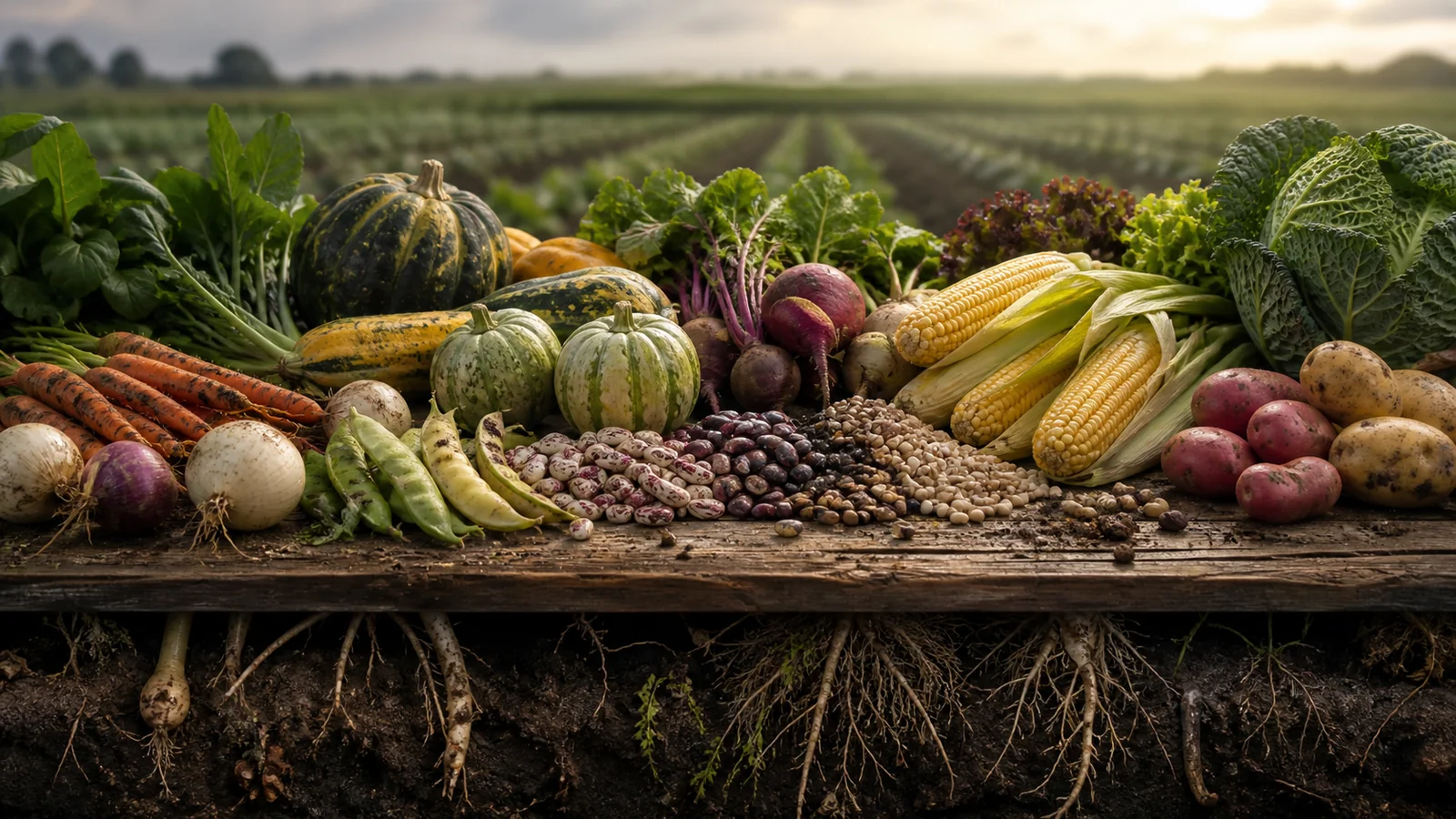
The idea that vegetables contain fewer nutrients than they once did is not invented. Historical datasets show real declines, and several of the changes are substantial. The trouble begins when every crop, country and nutrient is folded into one dramatic number. There is no scientifically defensible conversion in which one vegetable from the past equals five vegetables today.
The overall direction still deserves attention. Modern breeding and farming have often prioritised yield, speed, uniformity, transport and shelf life. Those traits are useful, but they do not guarantee that mineral and phytochemical accumulation keeps pace with growth. A larger harvest can contain a lower concentration of some nutrients per gram.
The major United States comparison
A 2004 study compared United States Department of Agriculture data for 43 garden crops, mostly vegetables, in 1950 and 1999. After adjusting for moisture, the crop group showed statistically reliable median declines of about 6% in protein, 9% in phosphorus, 15% in iron, 16% in calcium, 38% in riboflavin and about 15% in vitamin C. The authors explained that a change in analytical methods probably concealed part of the vitamin C decline; their estimated correction brought it close to 20%.
Those figures matter, but so does the rest of the result. Seven other nutrients did not show a reliable group decline. Most single food and nutrient comparisons were too uncertain to distinguish from no change. Among the individual comparisons that were statistically reliable, about 28% increased. The study supports real decline in particular nutrients across the crop group. It does not show that every modern vegetable has been emptied of nutrition.
The British comparison found several very large changes
A British analysis compared government food composition tables for 20 vegetables and 20 fruits from the 1930s and the 1980s. Vegetables showed significant average declines in calcium, magnesium, copper and sodium. The geometric mean ratio for newer versus older data was 0.81 for calcium, 0.65 for magnesium and 0.57 for sodium. Copper produced the most striking result, at 0.19 of the old value.
These results should not be dismissed, but they were not produced by a controlled trial. The samples did not come from the same fields, cultivars or seasons, and analytical methods changed. The author explicitly identified sampling and measurement as possible contributors. The findings raise an important question. They do not tell us exactly how much present-day broccoli replaces broccoli grown in 1936.
Yield dilution is plausible, but it is not the only mechanism
When breeding produces a larger fruit or more units per hectare, carbohydrate and water can rise faster than mineral uptake. The crop provides more food while the concentration per 100 grams falls. Fertilisation, irrigation, soil structure, harvest timing, ripeness, storage and light exposure can all change the result as well.
A simple soil depletion story is incomplete, but soil health still matters. Different cultivars grown in the same region can vary greatly, and soil may contain a mineral that the plant does not accumulate efficiently. Crop diversity, erosion control, organic matter and mycorrhizal fungi can support soil structure and the uptake of nutrients such as phosphorus and nitrogen. The outcome still varies with the crop, cultivar and growing conditions.
An organic label is not a laboratory analysis of every vegetable either. A large meta-analysis found higher concentrations of several antioxidant groups, and lower cadmium and pesticide residues, on average in organic crops. It did not show that every vitamin and mineral is higher in every organic item. Cultivar, soil, freshness and production method should therefore be considered together rather than reduced to one word on the label.
Carotenoids show why broad claims fail
Carotenoids such as beta-carotene and lutein vary with genetics, light, temperature, ripeness and storage. In a large study of 23 broccoli cultivars, cultivar, region and season explained meaningful parts of the variation. The tested compounds did not show a clear relationship with the cultivar's release date. In carrot, meanwhile, selection for orange roots increased carotenoid accumulation compared with wild carrots.
Modern vegetable is therefore too broad a category. One cultivar may contain less magnesium and more of a particular carotenoid. A ripe, recently harvested vegetable may also differ from the same type picked early, transported for days and stored for weeks.
Selenium follows geography as much as farming
Selenium is required for glutathione peroxidases, thioredoxin reductases and other selenoproteins with roles in the liver, thyroid and brain. Its concentration in food is strongly shaped by local geology and the wider food chain. Vegetables are not a predictable universal source, and the older datasets did not measure selenium consistently enough to establish a historical decline.
The interaction between selenium and mercury is especially important. Mercury has a high affinity for selenium, and laboratory and animal studies show that it can inhibit selenium-dependent enzymes while reducing the pool available to rebuild them. Meaningful exposure, particularly in someone with low intake or liver disease, can therefore narrow the margin of safety and make an adequate selenium supply more important. The evidence does not show that every mercury-exposed person needs more selenium than the recommended intake. Mercury-selenium binding does not guarantee clearance, and excess selenium can harm a person who is already replete. Exposure reduction comes first, followed by an assessment of diet, liver function and selenium status.
Atmospheric carbon dioxide also changes crop chemistry
Controlled growing experiments show that higher carbon dioxide can increase carbohydrate production while reducing the relative concentration of protein, iron and zinc in some C3 crops. The strongest datasets concern grains and legumes, so their exact figures should not be transferred to every vegetable. The mechanism still matters: a plant can grow more without accumulating every nutrient at the same rate.
Should we eat more vegetables now?
For most people, eating more vegetables is a sensible practical response. The measured declines in six major nutrients are not trivial, and some comparisons show very large changes. Research has not, however, established a universal historical multiplier. The historical studies did not test how much produce a person should eat, so eating more vegetables is a practical conclusion rather than a numerical conversion. In practice, many people eat too little fruit and vegetables even before differences between cultivars, soils and farming methods are considered. Documented declines and wide variation between cultivars provide another reason to build a margin of safety: more vegetables within a balanced diet, more colours and more plant families reduce dependence on a single cultivar or nutrient profile. Leafy greens, brassicas, roots, herbs, legumes, nuts and seeds complement one another.
Freshness and maturity matter. Preparation matters too. Gentle heating can improve the availability of some carotenoids, while prolonged boiling can move water-soluble vitamins and minerals into the cooking liquid. There is no single best method for every vegetable, which is another reason to vary both foods and preparation.
Testing and supplementation become relevant when there is an individual reason: a restrictive diet, gastrointestinal disease, blood loss, pregnancy, medication use, older age, low food intake or meaningful exposure. Supplements do not replace food volume and variety, and neither selenium nor beta-carotene should be treated as an automatic answer to possible changes in crop composition.
Practical conclusion
Significant and sometimes large declines have been measured in particular vegetables and nutrients. Evidence does not show that all vegetables have lost most of their value, and it does not provide an exact old-to-new conversion. The sensible response is to eat a generous variety of vegetables, choose fresh and mature produce when practical, use other whole-food mineral sources, and assess personal deficiency risk rather than guessing.
Research and sources
- Davis, Epp and Riordan: comparison of USDA data for 43 garden crops, 1950-1999
- Mayer: historical changes in the mineral content of 20 vegetables and 20 fruits
- Renaud and colleagues: cultivar, season and location effects in broccoli
- Ellison and colleagues: genetics of carotenoid accumulation in domesticated carrot
- Myers and colleagues: elevated carbon dioxide and iron and zinc in major crops
- Wu and colleagues: mycorrhizal fungi, plant biomass, nitrogen and phosphorus
- Barański and colleagues: composition of organic and conventional crops
- Combs and colleagues: selenium biomarkers after supplementation in healthy adults
- Alfthan and colleagues: selenium in the Finnish food system
- Spiller: mercury, selenium depletion and inhibition of selenoproteins
- Burk and colleagues: functional selenium deficiency in cirrhosis