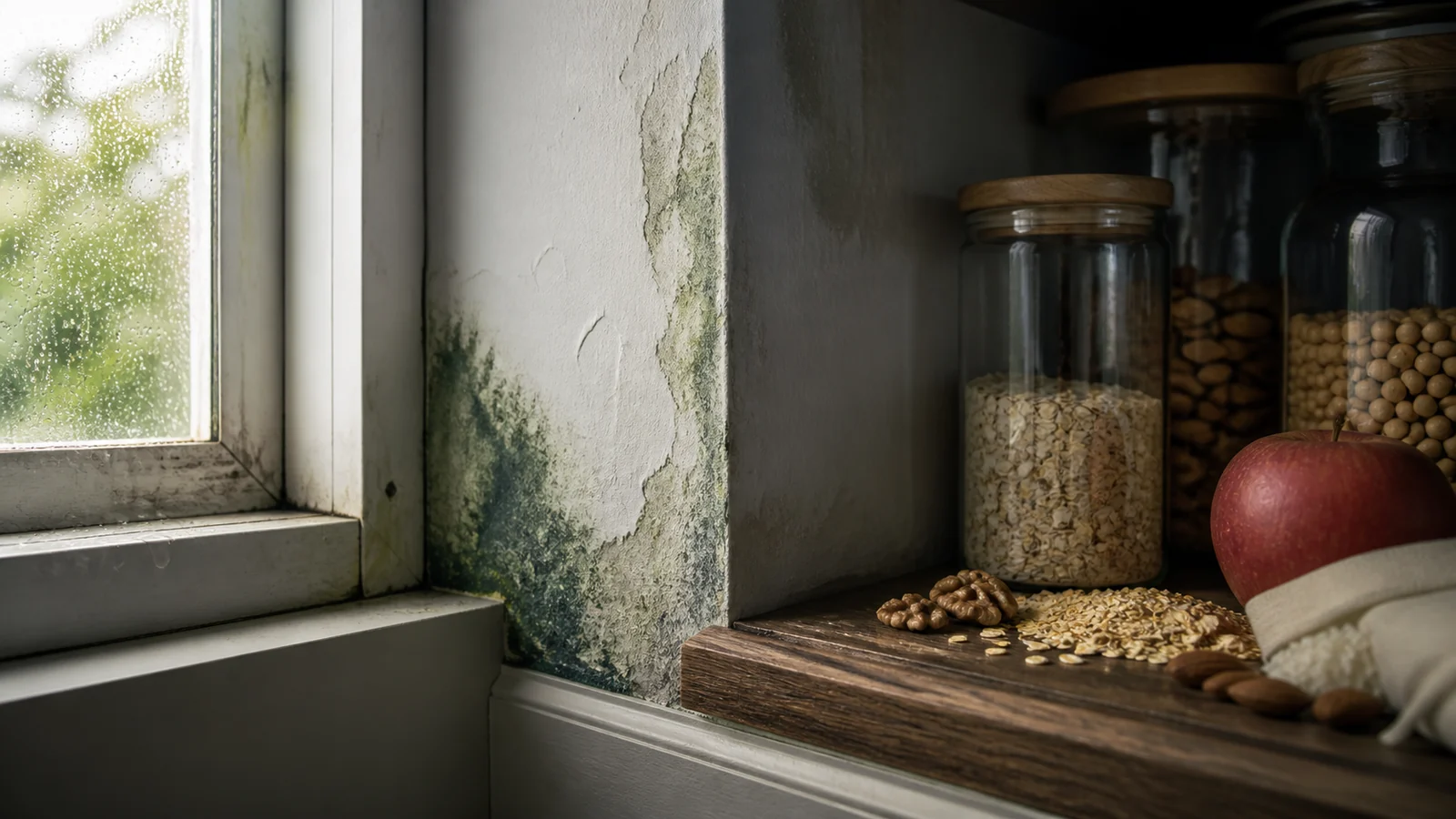
Mold spores are almost everywhere. They enter buildings through the air, windows, clothing and shoes. Their presence is not unusual by itself. Trouble begins when spores find persistent moisture and organic material such as wood, paper, cardboard, dust, fabric or food. That is why the first useful question is rarely "which mold is it?" It is "where is the water coming from, and why is this area not drying?"
Discussions about mold often collapse three different pathways into one. In damp buildings, people inhale spores, fragments, allergens and irritants. In food, they may ingest toxins produced by particular fungi. Invasive fungal infection is a separate medical problem that mainly threatens people with severe immune suppression or significant lung disease. Keeping these pathways separate makes the subject both less frightening and more accurate.
Where mold hides indoors
A poorly ventilated bathroom is the obvious example, but hidden moisture is often more important: a slow leak behind a kitchen cabinet, condensation on a cold external wall, a wet window frame, an unmaintained air-conditioning unit, furniture pressed against a damp wall, flooded carpet, a basement, a storage room, a leaking roof, or the cavity behind plasterboard. Sometimes the wall looks normal and the first clue is a musty smell that returns after rain or when the air conditioner starts.
A clean home can still develop mold. Cleaning does not repair a pipe, correct a thermal bridge, or ventilate a sealed room. Dust and organic debris can add more material for growth, but the effective response still begins with water control, drying and suitable removal, not simply spraying something with a strong smell.
What the health evidence supports
The US Centers for Disease Control and Prevention associates damp or moldy buildings with more respiratory symptoms, rhinitis, cough, wheeze, asthma exacerbation and allergic reactions. Hypersensitivity pneumonitis, an uncommon immune-mediated lung condition, can occur in susceptible people and requires medical assessment. People with asthma, mold allergy, chronic lung disease or significant immune suppression need extra precautions.
This evidence does not mean that everyone who enters a room with a small patch will become ill. It also does not mean that fatigue, headache or difficulty concentrating proves a mold illness. Those symptoms can be real while remaining nonspecific. Timing, the relationship to a building, respiratory findings, medical history and competing explanations matter more than a generic symptom checklist.
Three questions that clarify the problem
What is the source? A leak, condensation, flooding, food or workplace exposure. How does exposure occur? Inhalation, contact or ingestion. Who is exposed? A healthy adult, a child with asthma and a severely immunocompromised person do not begin with the same level of risk.
Mold in food is a different exposure route
Some fungi produce mycotoxins that may remain in food and can sometimes survive processing. Aflatoxins are especially relevant to grains, maize, peanuts and tree nuts stored under poor conditions. Long-term exposure can injure the liver and increase liver cancer risk. Ochratoxin A can occur in cereals, coffee beans, dried fruit and wine and is toxic to the kidneys. Patulin is chiefly associated with damaged apples and apple products.
This does not make every nut or apple dangerous. Food controls, dry storage and dietary variety reduce risk. Visible mold, a musty smell, damp packaging or a marked texture change are still reasons not to "taste a little." In many foods, fungal threads extend beyond the patch that can be seen.
What to discard and what can sometimes be trimmed
Bread and baked goods, soft cheeses, yoghurt, cream, jam, cooked leftovers, pasta, grains, nuts and soft fruit or vegetables with mold should generally be discarded. Do not sniff moldy food closely because this can send spores into the nose and airways. Removing the green spot from one slice does not make the rest of a loaf safe.
Very hard cheese and firm fruit or vegetables can sometimes be saved by cutting at least 2.5 centimetres around and below the affected area without dragging the knife through the mold. When in doubt, particularly for a pregnant person, young child, older adult or immunocompromised person, saving a small amount of food is not worth the uncertainty.
Black mold is not a diagnosis
Black sounds ominous, but colour alone does not measure toxicity. Dark, green, white and other molds can grow under different conditions, and identifying the species rarely changes the first household action: stop the water and remove the growth safely. Even a species capable of producing a toxin does not produce it at all times and under all conditions.
Routine one-off air sampling is therefore not an automatic answer. There is no simple health standard for a "safe" airborne spore count in a home, and a short sample may miss a problem or produce a number that is difficult to interpret. Visual inspection, odour, moisture measurement and leak detection often provide more actionable information. Professional investigation is useful when the source is hidden, there is a dispute, or previous remediation has failed.
What about urine mycotoxin tests?
Finding a substance in urine does not prove that it came from a wall or that it caused a person's symptoms. Mycotoxins can also enter through food and may be detected in healthy people. The CDC has warned about commercial urine mycotoxin tests that lack appropriate clinical validation because disease-predicting thresholds have not been established. An uncertain result can generate fear, expensive treatment and a missed alternative diagnosis.
How to deal with indoor mold effectively
Fix the water source first. Otherwise mold returns. Water-damaged materials should be dried promptly, ideally within 24 to 48 hours. Indoor relative humidity is generally best kept around 30 to 50 percent, with bathroom and cooking moisture vented outdoors where possible.
Match the response to the material and extent. A small area on a hard surface can often be cleaned with water and detergent and then dried fully. Deeply affected plasterboard, insulation, acoustic tiles, carpet and other porous materials may need replacement. Painting over growth is not remediation.
Know when not to do it yourself. Extensive growth, sewage contamination, polluted floodwater, mold inside HVAC equipment, repeated recurrence or a vulnerable occupant calls for suitable professional help. During cleanup, limit spread, use gloves, eye protection and an appropriate N95 respirator, and keep children and high-risk people away.
Never mix cleaning products. Combining bleach with ammonia, acids or other cleaners can release dangerous gases. A harsh chemical also cannot substitute for removing damaged porous material and drying the structure.
Can nutrition or supplements protect against mold?
Protein, zinc, selenium, vitamins and dietary antioxidants support immune function, biological barriers and antioxidant systems. That matters for general health, but it does not turn a supplement into an antidote to continuing exposure. Sleeping in a damp room while expecting an antioxidant, binder or detox protocol to cancel the source is the wrong order of operations.
As with other environmental health problems, sequence matters: identify the source, reduce exposure, repair the environment, assess symptoms and medical vulnerabilities, and only then consider nutritional support suited to the individual. Sometimes repairing a leak is the most important health intervention in the house.
When medical assessment is needed
New wheeze, shortness of breath, worsening asthma, persistent cough, or symptoms that repeatedly track with a particular building deserve assessment. An immunocompromised person with fever, chest pain, breathlessness or cough after exposure should seek medical care promptly. Significant breathing difficulty is urgent.
The practical conclusion
There is no need to panic over every dark mark, and no reason to live with a wet wall. Indoor mold is first a moisture problem. Moldy food is a food-safety problem that can involve mycotoxins. Fix the source rather than the colour, take vulnerable people seriously, and be cautious with tests and detox claims that promise more certainty than the evidence can provide.
Sources
- CDC/NIOSH: Health problems related to damp buildings and mold
- CDC/NIOSH: Mold testing and remediation
- CDC: Stachybotrys and black mold facts
- CDC: Unvalidated urine mycotoxin testing
- USDA: Molds on food, when to use and when to discard
- US Environmental Protection Agency: A brief guide to mold, moisture and your home